
How to Choose the Right UPS System for Your Business
For many businesses, a power outage is more than an inconvenience. It can interrupt operations, affect customer service, damage sensitive equipment and result in significant financial losses.
This is why Uninterruptible Power Supply systems have become an important part of business infrastructure across Nigeria. However, choosing the right UPS system is not simply about buying the highest capacity system available.
The right solution depends on your power requirements, the equipment you need to protect and how long your business needs to remain operational during a power interruption.
Here are the key factors to consider.
1. Understand Your Critical Power Requirements
The first step is identifying the equipment that requires uninterrupted power.
For some businesses, this may include servers, network equipment and security systems. For others, it may involve medical equipment, production systems, financial technology infrastructure or telecommunications equipment.
Not every electrical appliance needs to be connected to a UPS.
Separating critical loads from nonessential loads allows businesses to design a more efficient and cost effective power backup system. A professional load assessment can determine how much power your critical equipment consumes and help prevent the system from being either undersized or unnecessarily oversized.
2. Choose the Right UPS Capacity
UPS capacity is usually measured in kilovolt amperes (kVA) or kilowatts (kW).
One of the most common mistakes businesses make is selecting a UPS based only on their current power consumption.
A properly designed UPS should accommodate the actual load being supported while providing sufficient capacity for peak demand and reasonable future growth.
For example, a growing data room, office or production facility may require additional capacity within the next few years. Installing a system with no room for expansion could result in costly upgrades sooner than expected.
This is why understanding both your current and projected power requirements is essential.
3. Determine How Much Battery Backup Time You Need
UPS systems can provide power for a few minutes, several hours or longer depending on the battery configuration and system design.
The required backup time should be based on the role of the UPS.
In some facilities, the UPS only needs to provide power long enough for a generator to start and stabilise. In others, the system may be required to support critical operations for an extended period.
Businesses should clearly define their backup objective before selecting battery capacity.
Key questions include:
- How long does the facility need to remain operational during an outage?
- Is there a generator available as secondary backup?
- Which equipment must remain operational at all times?
- How frequently does the facility experience power interruptions?
The answers will directly influence the required battery capacity.
4. Consider the Type of UPS Technology
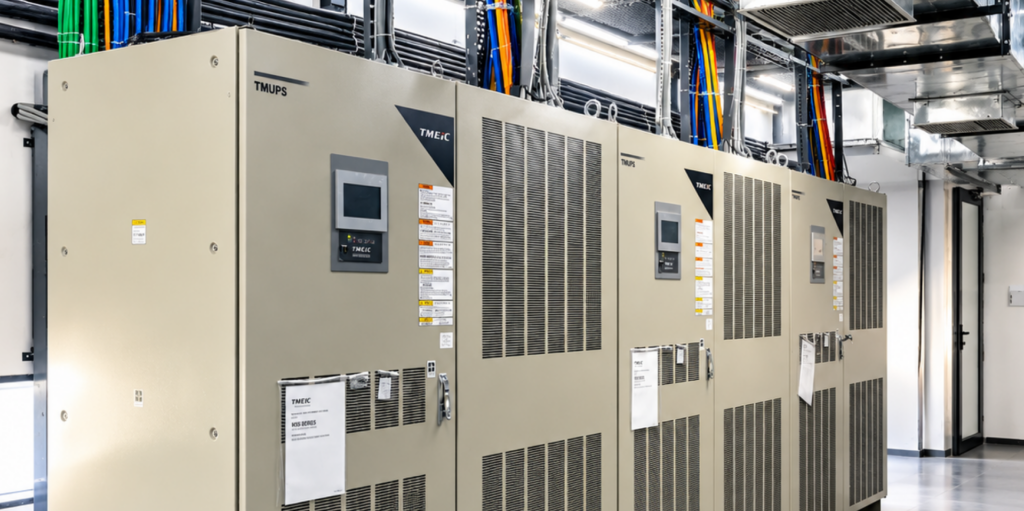
Different UPS technologies are designed for different applications.
For critical infrastructure and sensitive equipment, online double conversion UPS systems are often preferred because they provide a high level of power protection and continuous conditioning.
The choice should be based on factors such as power quality, equipment sensitivity, uptime requirements and operational risk.
Businesses supporting data centres, telecommunications infrastructure, financial operations and other mission critical environments may require a more advanced UPS architecture than a standard office environment.
The important consideration is not simply purchasing a UPS. It is selecting a system designed for the operational importance of the equipment it will support.
5. Plan for Scalability
Business power requirements rarely remain the same.
As organisations expand, they may introduce additional servers, machinery, cooling systems or other equipment that increases power demand.
A modular UPS system can provide greater flexibility by allowing capacity to be expanded as requirements grow. This can help businesses avoid replacing an entire system when additional capacity is required.
Scalability is particularly important for facilities with planned expansion or rapidly changing power requirements.
A UPS solution should therefore be viewed as long term infrastructure rather than a short term equipment purchase.
6. Consider Redundancy and Reliability
For businesses where downtime is unacceptable, one UPS system may not provide sufficient protection.
Redundancy provides an additional layer of resilience by ensuring that critical operations can remain supported if a component or UPS module requires maintenance or experiences a fault.
The appropriate level of redundancy depends on the operational importance of the facility.
For example, critical infrastructure may require N+1 redundancy, allowing the system to maintain operations even if one component becomes unavailable.
The cost of redundancy should be considered against the potential cost of downtime.
For many businesses, the financial and operational consequences of an outage can significantly exceed the investment required for a resilient power architecture.
7. Look Beyond the Equipment
Choosing the right UPS system also means choosing the right technical partner.
Installation quality, commissioning, maintenance and technical support all affect the long term performance of the system.
Businesses should consider the availability of local engineering support, replacement parts, preventive maintenance and emergency response.
A UPS is a critical part of your power infrastructure. Its reliability depends not only on the equipment itself but also on how well it is designed, installed and maintained.
Making the Right Investment
The right UPS system should protect your critical operations today while supporting the growth of your business tomorrow.
Before making a decision, businesses should assess their critical load, determine the required backup time, consider future expansion and evaluate the level of reliability their operations demand.
At Royal Power & Energy Limited, we provide UPS and critical power solutions designed around the specific requirements of commercial, industrial and mission critical facilities.
Planning a new UPS installation or reviewing your existing power infrastructure?
📩 Contact our team at sales@rpeltd.com to discuss your power requirements and explore the right solution for your business.